SPCX: Navigating Event Windows #1 and #2 with AI Agentic Analysts and Auditors
Window 1 asked whether the fee would keep rising into a release with no precedent. Window 2 asked by how much it would fall after one. The record answers both, and it does not answer them alike.
Ed Blount, Tom Daniels, Dan Hammond, and David Schwartz Advanced Securities Consulting LLC
Section 1Executive Summary
Between July 30 and August 20, 2026, ASC's governed AI inference vector models issued twenty-two dated editions on the securities-lending market in SpaceX (SPCX) across the first two IPO lockup releases of August 6 and August 20. Proof of Concept 5 tested whether an AI-assisted securities-lending inference process could remain useful and controlled when model history was insufficient, the event had little precedent, data quality changed intraday and human judgment remained necessary. Each distributed edition stated its market-state read in writing, with the settled observable that would prove it wrong, before the resolving data existed. This report prints every edition in the order it was made, including the internal alphas that were never sent, the edition withheld as late, the two editions held on the auditor's data question and the two release-day editions that were held, and scores the distributed editions against the September 3 settled record; internal, withheld and held editions are printed and marked as such rather than scored.
22
editions on the record, July 30 to August 20: distributed, internal, withheld and held
5 of 5
distributed Window 1 editions whose stated conditions held through settlement; none lapsed
6 of 6
distributed Window 2 editions regret under the retrospective direction diagnostic; no Window 2 edition is claimed as a hit
The working hypothesis the experiment began with was that successive releases could overwhelm demand and crush the stock. They did not. The stock fell to an all-time low close of 108.27 the session before the first release and rallied off it; through the first countdown the editions read HOTTER against a stock still searching for a floor, then turned to COOLER at T+1 on the day the re-rates came down. Into the second release the stock eased, closing at 134.00 on August 20 against 143.34 two sessions earlier. The second window was less clean. The editions carried a fixed inference box with a direction, a range and a stated confidence, the settled fee moved less than five basis points on most days, and when an anomalous trade appeared in the real-time blotter (2mm shares at 58%) the agentic auditor held that day's editions until the print was corrected from a new trade print to an internal adjustment, while the release-day edition was held pending reconciliation.
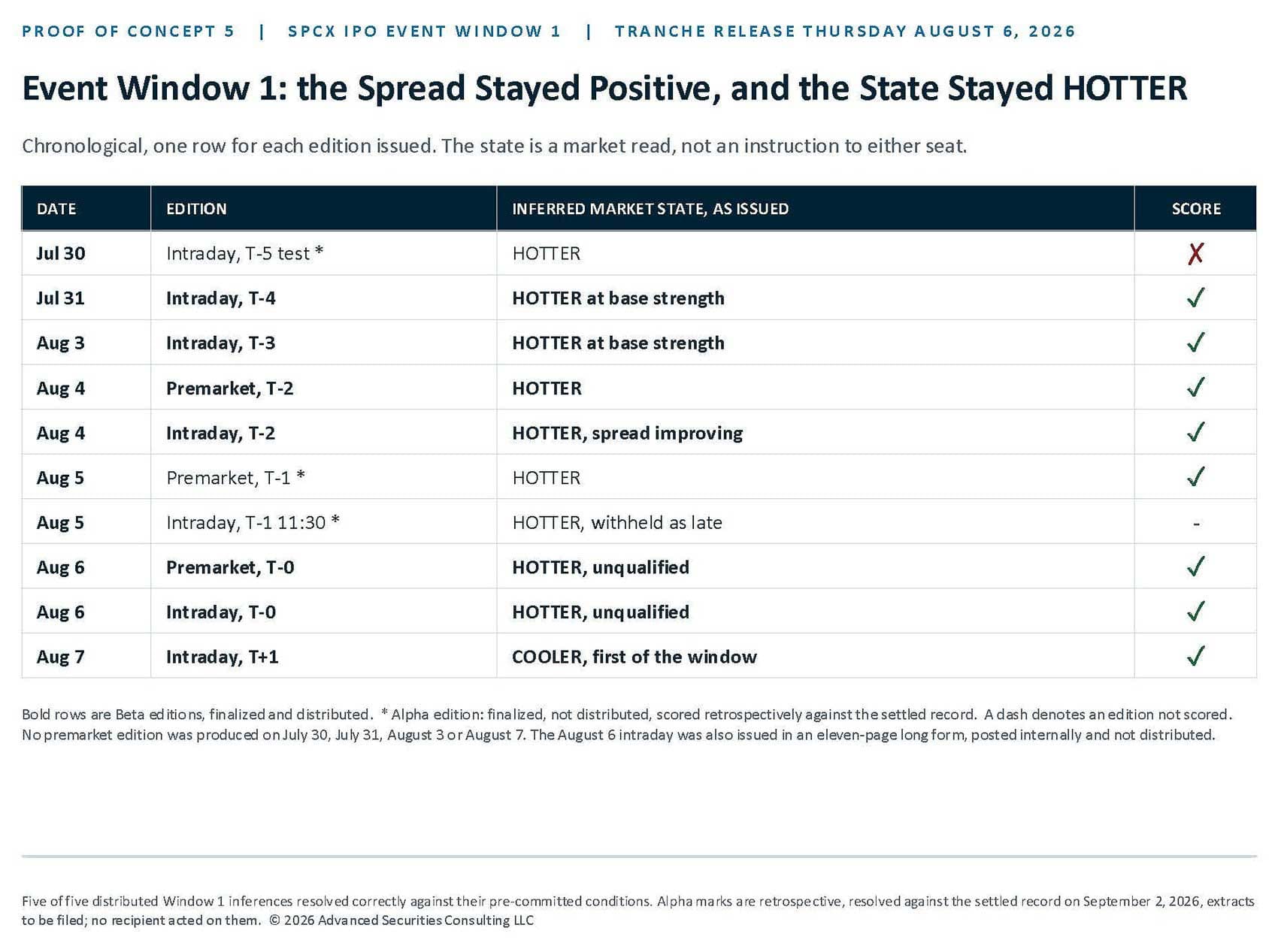
Exhibit 1. Event Window 1: the spread stayed positive, and the state stayed HOTTER. One row for each edition issued, July 30 to August 7, 2026. Bold rows are Beta editions, finalized and distributed; asterisked rows are alpha editions, finalized and not distributed, scored retrospectively against the settled record. The state is a market read, not an instruction to either seat. The scoring conventions and the terms used are defined in Section 2. Graphic supplied by the Executive Director, September 20, 2026.
The distributed editions were produced by a governed framework: written instructions, specialist agents applying a human-defined mandate, an independent agentic auditor (independent here meaning a separate instance with its own context and a written adjudication protocol, not an outside party), and a human who decided what could be claimed. The quantitative models entered that framework as an input it evaluated each session. SpaceX priced on June 11, listed on June 12, and the daily lending file for the name began on July 28. The eight-model deep ensemble therefore reached the first countdown with a settled fee record on the name that began on June 15, about thirty-three sessions, of which ASC had held the daily file for two days, and the framework held its output below the validation gate rather than publishing it, as the design had anticipated for a name this new. The same framework carried the five Window 1 reads, wrapped the Window 2 quantitative output in an inference box with a stated range and confidence, held the August 19 editions when the agentic auditor questioned an anomalous blotter trade, and they were scored in retrospect against the adjusted point, and held the August 20 edition on a tape whose manifest did not reconcile. Models of the same families, trained on a sufficient record, had carried the earlier proofs of concept, KLAR among them; the governance introduced here is what let the line run on a name where no such record yet existed.
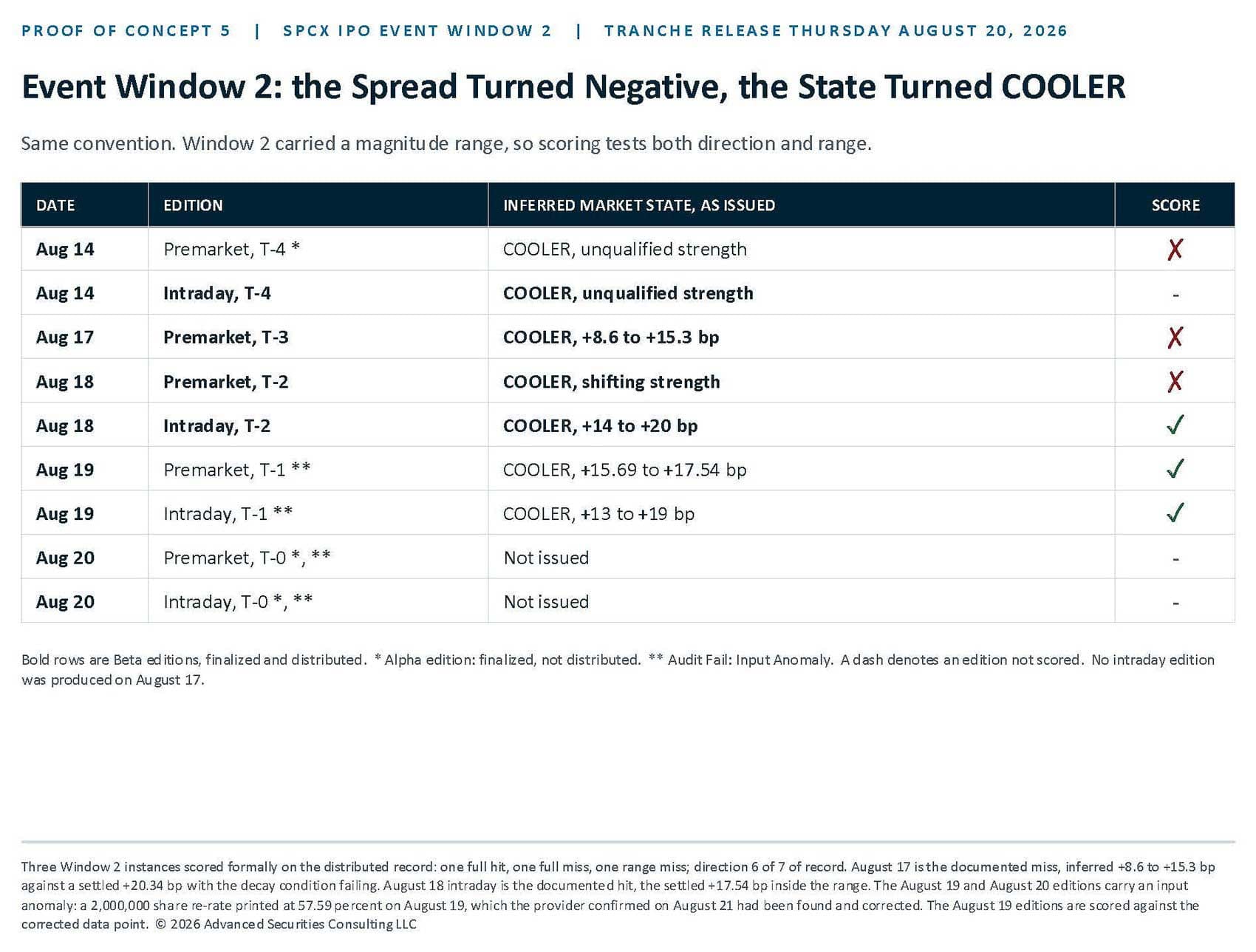
Exhibit 2. Event Window 2: the spread turned negative, the state turned COOLER. Same convention; Window 2 carried a magnitude range, so scoring tests both direction and range. Double asterisk marks the editions held on the August 19 input anomaly, a trade in the real-time blotter (2mm shares at 58%) that the agentic auditor questioned and that was later corrected from a new trade print to an internal adjustment; the August 19 editions were not distributed and are scored in retrospect against the adjusted data point. Graphic supplied by the Executive Director, September 20, 2026.
What the two windows produced, beyond the scored record, is a working division of labor between the quantitative AI models and the language models, which this report calls the reasoning model. The quantitative rungs ran in ASC's shop. The agentic analysts held the corporate-action taxonomy, the Project Instructions and the context files of earlier events, read the model output against them, and wrote each edition's market state with its pre-committed conditions. The agentic auditor tested every edition for provenance, stale data, arithmetic and overstatement before a human released it. That division is portable. The instruction set and the context files can be furnished to a tester's own Claude instance; ASC runs the linear models and the non-linear models in its own shop and delivers the results through the inference state record (ISR), so that the analyst and the auditor do their reading inside the tester's walls, against the tester's own tickets or a vendor's aggregates, under the same rules that governed these twenty-two editions. How the analysts read, what the auditor refuses, and what the ISR carries are the subject of the technical report and of the tester program that follows it.
Section 2Event Background
SPCX combined minimal trading history, an IPO of unprecedented size, a rare staggered release structure and observable stock-loan demand. Nine scheduled steps would pass before all shares became eligible to trade, stretching the supply transition across roughly a year. SpaceX priced on June 11 and listed on June 12; every tranche date on this page is anchored to the June 11 pricing. SpaceX's first earnings report, for the second quarter, came on Tuesday, August 4, and under the amended S-1 the first tranche released on the second full trading day after it, Thursday, August 6, 2026; the second release fell on Thursday, August 20. The later tranches followed the calendar, on September 9, September 24, October 9 and October 24 (a Saturday, rolling to the next business day), with the 180-day lockup expiring December 8 and the insider block under the 366-day lockup releasing on June 12, 2027; only the bonus tranche and the third-quarter slug were conditioned on price and earnings tests. Index inclusion followed the listing: SPCX's addition to the Nasdaq-100 created mechanical borrow demand from index-tracking funds that the deluge thesis did not weigh. The July 31 edition sized the first tranche at approximately 920 million shares, about 1.4 times the IPO float of 638 million; the August 20 release covered roughly 319 million shares. Before any settled lending data existed for the name, the reasoning model, the qualitative layer of the production line, worked through the prospectus mechanics and produced the supply ladder that every later edition carried: which shares released on which date, by what mechanism, to which holder class, and which conditional windows would and would not open. ASC's earlier posts on the name set out that ground: SpaceX IPO: What Shorts and Stock Lenders Cannot Afford to Miss (March 31, 2026), SPCX: The Microeconomics of Short Selling into the Largest IPO in History (May 28), SPCX Day One: $160.95 and the Short Book Nobody Was Ready For (June 14), SPCX Window One: Three Borrowers, One Lendable Pool (June 22), and, at CSFME, Information Asymmetry and the Staggered Lockup: Analyzing the SPCX E1 Supply Shock (August 8).
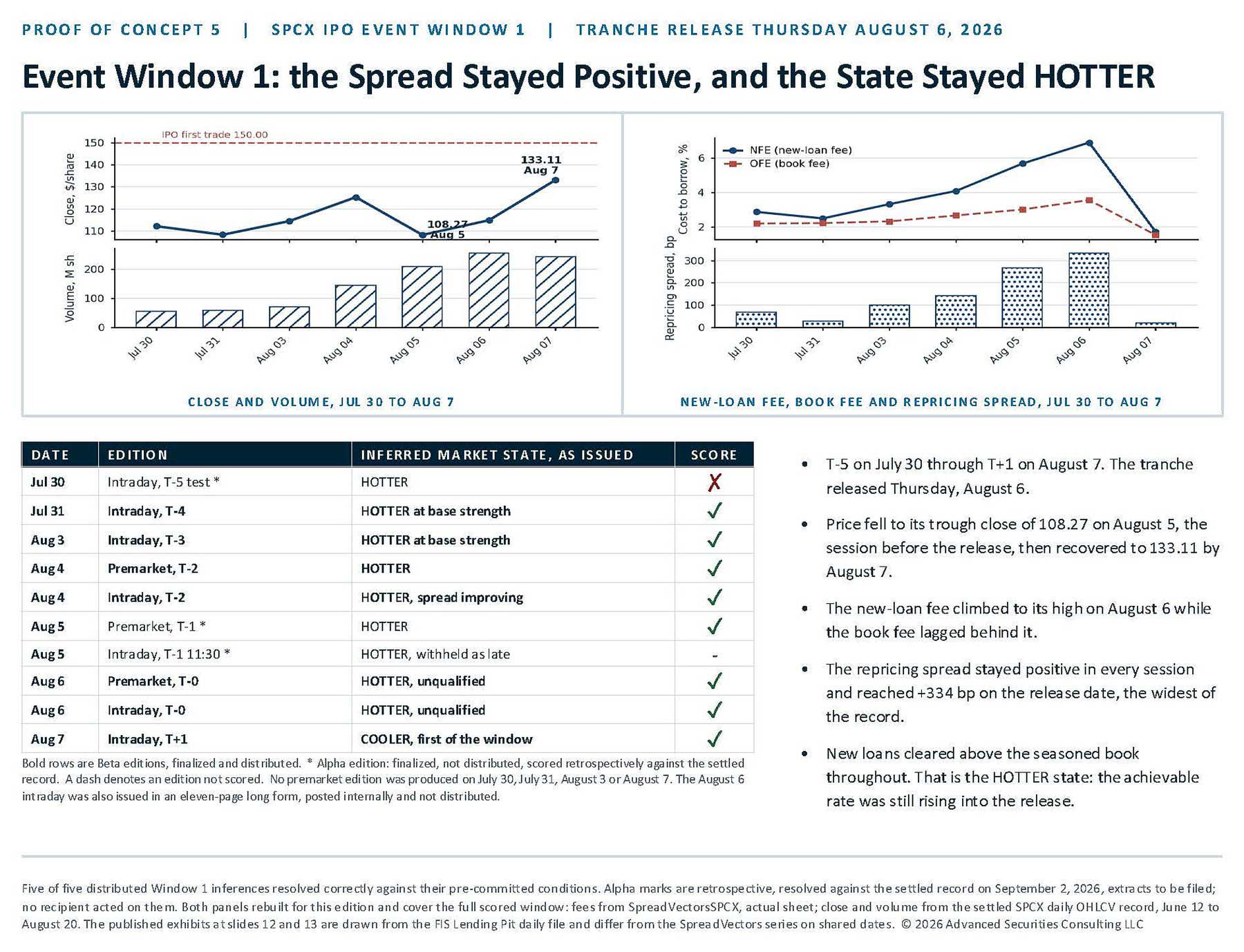
Exhibit 3. Event Window 1: close and volume; new-loan fee, book fee and repricing spread, July 30 to August 7. Fees from the SpreadVectorsSPCX actual sheet; close and volume from the settled SPCX daily OHLCV record. The repricing spread stayed positive in every session and reached +334 bp on the release date; new loans cleared above the seasoned book throughout. Graphic supplied by the Executive Director, September 20, 2026. Fees in this exhibit are on the SpreadVectors basis, which differs from the FIS Lending Pit daily file quoted in Section 5.
The data history is the fact that governs everything that follows. Live access to the daily securities-lending feed for SPCX began on July 28, when the team also requested backfill to May 1. Training runs on the name began the week the first countdown began. A contemporaneous note from the modeling lead on July 29, reporting the first model output, put the caution in the model's own terms.
Even the model itself cautions that it is not doing a good job with this thin a sample.Modeling lead, internal note, July 29, 2026
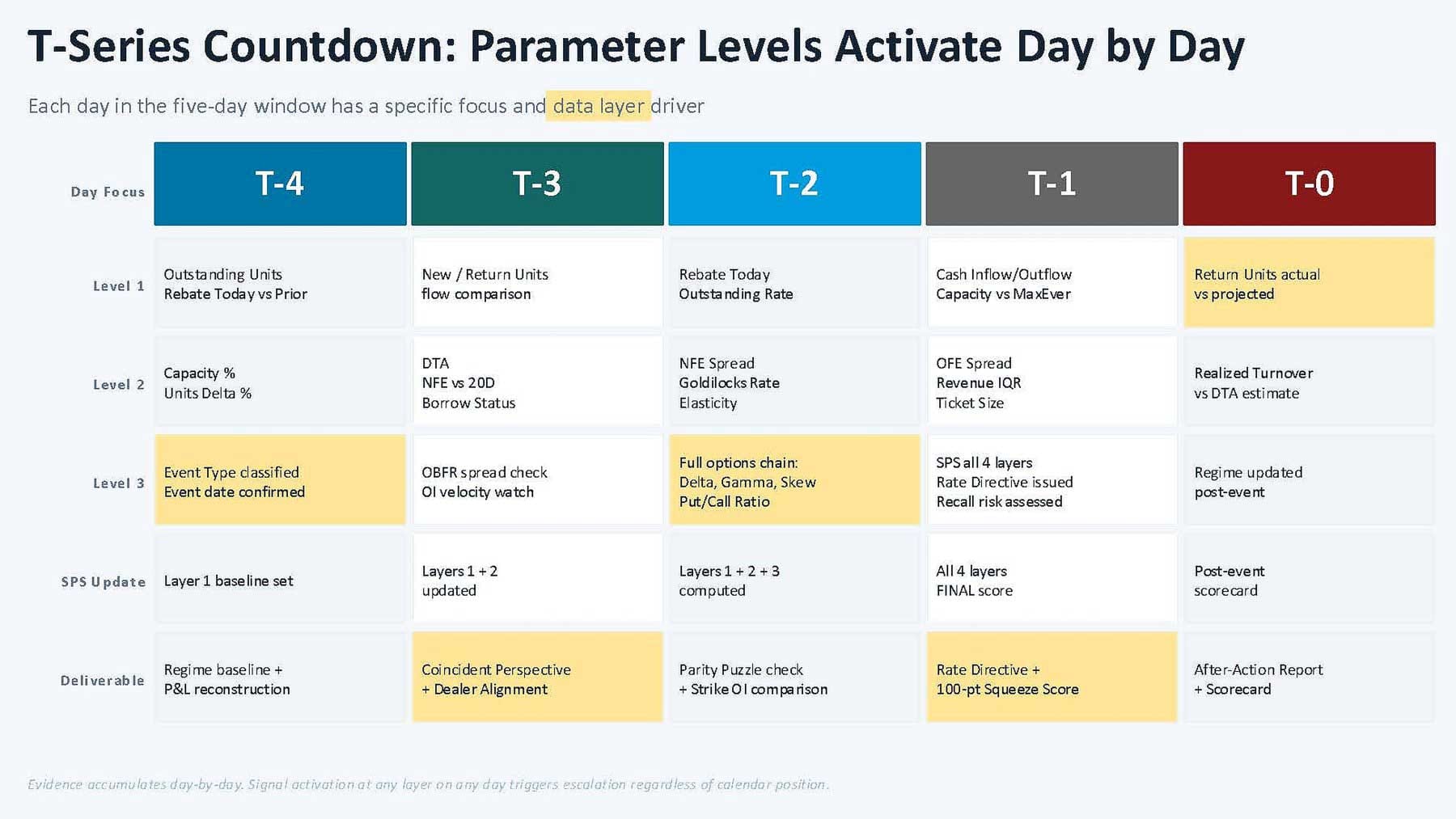
The countdown method, written down in Proof of Concept 4 and demonstrated on KLAR in March 2026, ran from T-5 to T-0 with a fixed cadence: each session's edition stated a market state, a pre-committed condition under which the state held, and the settled observable that would falsify it.
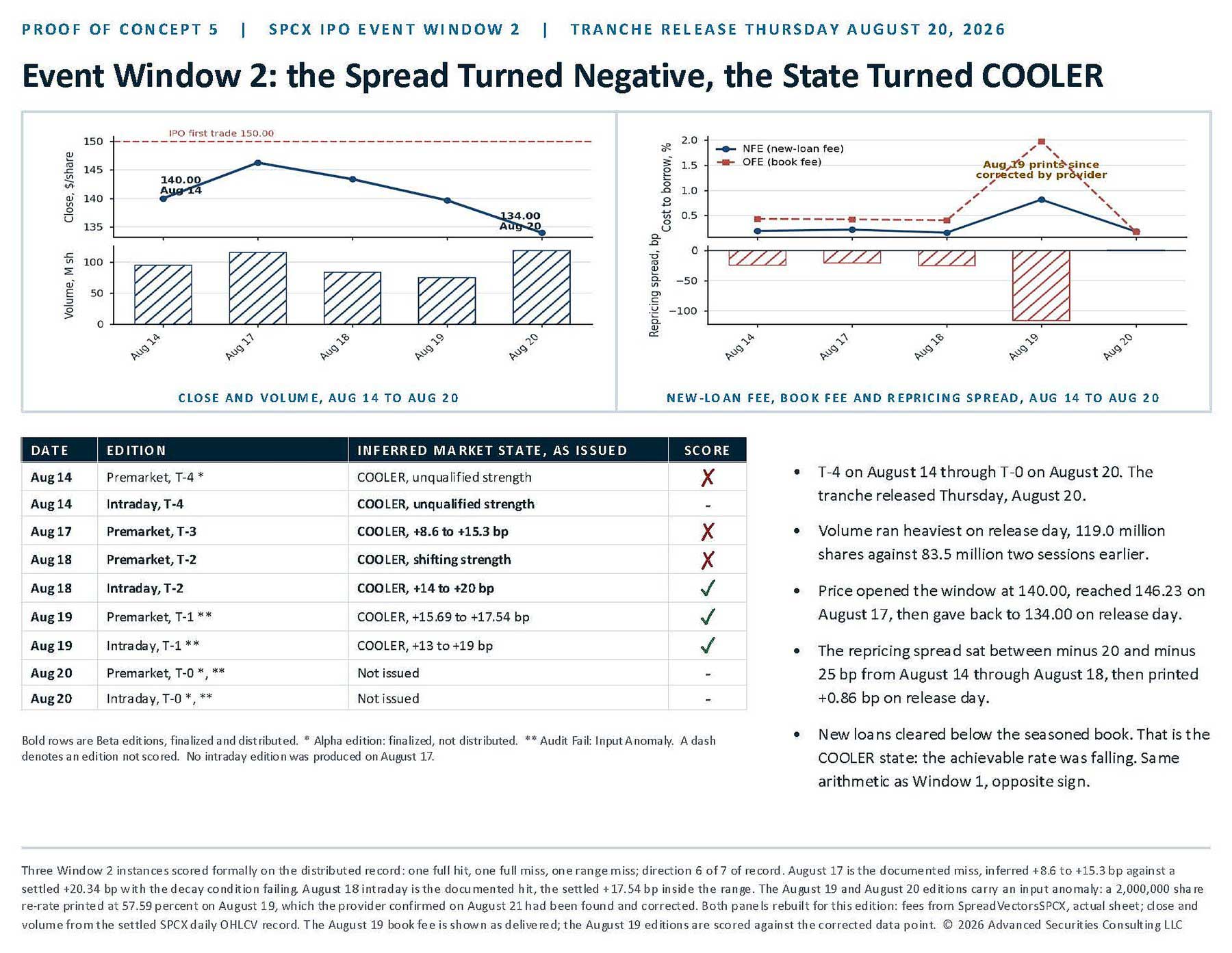
Exhibit 4. Event Window 2: close and volume; new-loan fee, book fee and repricing spread, August 14 to August 20. Same sources. The repricing spread sat between minus 20 and minus 25 bp from August 14 through August 18 and printed +0.86 bp on release day; the August 19 book fee is shown as delivered, before the anomalous blotter trade was reclassified as an internal adjustment. New loans cleared below the seasoned book: the COOLER state, same arithmetic as Window 1 with the opposite sign. Graphic supplied by the Executive Director, September 20, 2026.
Scoring conventions used on this pageHOTTER means the achievable lender rate was expected to improve; COOLER means it was expected to ease. An edition is a dated form of record. Distributed editions went to beta recipients; internal alphas, editions withheld as late and held editions appear in italic and are not scored except where noted as a retrospective control. Under the instruction set every read is a conditional inference: it holds while the conditions stated with it hold, and it lapses when they fail, rather than being scored as a miss. In Window 1 each edition is therefore marked on whether the condition it published in advance held through the resolving session, evaluated on the settled intrinsic spread (new-loan fee less seasoned book fee); a HOTTER read holds while the spread holds or widens and no stated reversal condition fires, and the mark Held means the inference did not lapse. This is a record of consistent state classification against stated conditions, not a fixed-horizon forecast score. In Window 2 each edition is scored on the adjudicated point, the next session's settled new-loan fee, against the issued range. The settled-change column is the day's move in the new-loan fee and is shown for context only; one Window 1 row, July 31, calls HOTTER on a negative settled change and is marked Held on its settled spread condition, not on that column. The retrospective direction diagnostic is a separate, after-the-fact loss defined in Section 3. On this page the labels Pre-committed and Retrospective distinguish what an edition stated in advance from what was computed afterward. Confidence figures quoted from the editions are scores on the 100-point confidence framework as the editions stated them, not calibrated probabilities. The editions as delivered carried the labels HOLD and PUSH under a Rate Directive heading; this page describes the same reads as market states, HOLD corresponding to HOTTER and PUSH to COOLER, and quotes the delivered labels where an edition is reproduced.
Terms used on this pageNew-loan fee (NFE). The fee at which a new loan prices on the day, settled basis, in basis points per annum; Window 2 ranges and adjudicated points are levels of this fee. Book fee (OFE). The fee the seasoned lender book already earns. Intrinsic spread. NFE less OFE on the FIS Lending Pit daily file; the quantity Window 1 conditions are marked on. Repricing spread (SpreadVectors basis). The same idea on a different construction, shown in Exhibits 3, 4 and 8; the two are not interchangeable. Achievable rate. The lender rate obtainable on live tickets during the session, in percent, quoted in the August 3 entry. Settled change. The day's settled NFE less the prior session's, in basis points; context only. Adjudicated point. The next-session settled NFE against which a Window 2 range is scored. Issued range. The level range, in basis points, an edition stated for the adjudicated point. Option-implied borrow. The borrow cost implied by put-call parity, annualized in basis points; ASC's inference, not an observed rate. Pit ask. The rate lenders asked in the Lending Pit on the day quoted. Confidence. A score on the 100-point confidence framework as the edition stated it; not a probability. Reasoning model. The language-model layer of the production line: the agentic analysts and the agentic auditor, reading quantitative output against the instruction set.
Section 3Model Performance Evaluation
Exhibit 5. T-Series Countdown: parameter levels activate day by day. Each day in the five-day window has a specific focus and data-layer driver: Level 1 (units, rebates and cash flows), Level 2 (capacity, spreads and the Goldilocks rate), Level 3 (event classification, the options chain and the Squeeze Prediction Score across four layers), the SPS update, and the deliverable of the day, from the regime baseline at T-4 to the after-action report and scorecard at T-0. Evidence accumulates day by day; signal activation at any layer on any day escalates regardless of calendar position. This is the method the SPCX editions ran under, written down in Proof of Concept 4. The row labels Rate Directive and Squeeze Score are the countdown's own deliverable names; the market state each edition carried is described on this page as HOTTER or COOLER.
Which rung may publish: the fitness decision, session by session
The governance enhancement this proof of concept introduced to the quantitative models is a rung-fitness decision made in writing every session: which rung of the model ladder has enough history behind it to publish, and what the edition may say when the answer is none of the upper rungs. On SPCX the answer was known before the first window opened. No one expected a name that priced on June 11, with a daily lending file that began on July 28, to supply enough observations to train the eight-model deep ensemble, and the regression rungs were squeezed by the same short span. The ensemble was therefore held below its validation gate in both windows and its output entered no distributed edition. On August 13 the first inference box built from its output reported a direction confidence of 14 percent, and the two editions carrying it stayed internal. The July 31 edition capped its confidence at 75. The ladder, whose rungs run from momentum through the closed-form regression models to the eight-model deep ensemble, was stopped at momentum, and the editions said so: the July 31 edition led with the option-implied forward borrow rather than a model forecast, and the August 3 edition printed sixty tickets of re-rate direction rather than a point estimate. This was controlled abstention, the system declining unsupported complexity rather than dressing thin history in fluent prose.
Was abstention pre-specified?
Pre-specified training-history requirement, observations available, decision and consequence, by window
Rule
Window 1 (first countdown, July 30)
Window 2 (second countdown, August 13)
Minimum training history for the non-linear deep-learning rungs
90 settled sessions on the name; rule finalized in writing on July 31, 2026, before the first distributed edition
Observations available
About 33 settled sessions from the June 15 onset; daily file held by ASC since July 28
About 40 settled sessions
Decision
Below the gate
Below the gate
Consequence
Ensemble output entered no distributed edition; the five Window 1 reads were the reasoning model's, each with a pre-committed condition
Ensemble output entered no distributed edition; the Window 2 boxes carried ranges and confidence stated by the reasoning model, with the ensemble's own 14 percent staying internal on August 13
The gate, the observation counts and the consequence as the record states them. The requirement and its date precede both windows; the decision follows from the count, not from the ensemble's later error record, which Section 3 reports separately as evidence the decision was sound.
The evidence the fitness decision rested on is in the record. On the four sessions where a one-step forecast could be scored against the settled fee, the ensemble's errors exceeded the naive carry's, with mean errors up to 4.10 percentage points of fee (410 bp, on the four Window 1 sessions, when the fee ran between 300 and 700 bp) against carry errors of 0.05 percentage points; on a fee whose settled record was about thirty-three sessions old and that barely moved between sessions, the carry's no-change forecast is the expected winner and the comparison says more about the sample than about the models. The linear rungs read the same way. A walk-forward replay of seven closed-form models on the SPCX new-fee series over 40 origins from June 17 to August 19 finds the best direction edge, Drift5 at 0.600 against a base rate of 0.525, inside its own binomial standard error, with persistence carrying the lowest level error at 40.3 bp (mean over the 40 origins) and no stable ranking across data variants. No trailing-window model anticipates the August 7 reversal, which is the mechanism the editions carried in their pre-committed conditions and the reason the reasoning model, not a rung of the ladder, produced the Window 1 reads.
What the reads show beyond a simple rule
A reader will ask what the record would have shown without the framework. A one-line rule, HOTTER while new loans print above the seasoned book, reproduces every Window 1 mark, because the intrinsic spread stayed positive through the countdown; the Window 1 marks are therefore not evidence that the reasoning model saw what a rule could not. What the rule does not reproduce is on the record in three places: the August 3 withdrawal of a morning shift when sixty live tickets contradicted it, the August 7 turn to COOLER on 142 of 148 re-rate tickets while the spread was still positive at settlement and the rule would still have read HOTTER, and the August 19 and 20 holds, which no rule on the fee series could have produced because the fault was in the input, not in the signal. In Window 2 a naive carry on direction would have regretted on the same flat sessions the distributed editions regretted on. This comparison is a reconstruction, stated as a limit on what the marks show rather than as a measured advantage.
This is a finding about data on one name, and the same model families have a record on names where the data existed. In Proof of Concept 1 (January 2025, reported on the ASC website in Traders' AI-Boosted Edge in Securities Lending of January 29 and Deep Learning vs. ARIMA of February 23, and in the CSFME article How Deep Learning is Revolutionizing Securities Lending of February 25, 2025) the deep-learning ensemble outperformed ARIMA on public lending data, with more than 72 percent of its correct forecasts at turning points and traders acting on AI-predicted reversals accounting for over 60 percent of $155,476 in net savings against the Goldilocks benchmark. Proof of Concept 2 (January to May 2025) tested the same model class against a custodian's own records on an agent lender's live book. Proof of Concept 3 (April to December 2025; final report of December 15, 2025) captured $12.2 million on Lennar in three sessions beginning November 25, 2025. In Proof of Concept 4, on the KLAR lockup of March 2026 (after-action report of March 10, 2026, published as KLAR: The Squeeze The Market Missed), the T-Series predictive models, benchmarked, calibrated and trained against the RPT corpus of confirmed historical events, identified a structural shortage when the market expected a supply deluge, and the outcome confirmed it: zero shares available and a 68.62 percent cost to borrow at the close of March 9. The models' measured record on the seasoned five-thousand-name universe the production platform serves every day is set out in the technical report; it is not summarized here because those figures await verification against the run manifests. What SPCX added was the governance that decides, on the record, when that history is present and when it is not.
Where the agentic layer wrapped the quantitative output
Gating was the smaller part of the enhancement. In four dated instances the reasoning model took quantitative product and returned it governed. On July 31 a second AI instance independently reproduced the option-parity extraction, 790 plus or minus 126 bp on the front segment and a 666 bp front-to-back spread at 4.7 standard errors, so that the figure the edition carried had been replicated before it was published, and the agentic auditor required that it be stated as ASC's inference rather than as observed fact. On August 3, before any number was quoted, an agent's review of the option chains rebuilt overnight (from 935 kilobytes to 86 megabytes, and from between four and fourteen strikes per snapshot to between 72 and 193) found the zero-days-to-expiry rows contaminated and 186 of 2,456 rows with null open interest clustered on nine dates where a vendor endpoint had timed out, and specified the fix; a synchronized quote capture was running on SPCX every sixty seconds by 13:44. On August 13 the inference box, with its direction, range, stated confidence and pre-committed conditions, was specified to be built automatically from the daily prediction file, so that in Window 2 the quantitative output entered every edition already wrapped in the terms on which it would be scored. And on August 14 a simple tape estimator assembled from the screened ticket feed placed within 1.15 bp of the settled fee against the carry's 4.12, the one scored observation (one session, August 14) in either window on which any instrument beat the carry. Each is the reasoning model inferring from, checking, or restating quantitative output; none is the layer producing a forecast of its own.
Where the auditor and the build refused
Beside that work sat the controls. The agentic layer enforced the validation boundary, tested evidence against human-defined instructions, capped confidence, and prevented unsupported output from entering the guidance. On July 31 the agentic auditor's first finding was that a sentence describing the options market as having raised its event-week borrow price stated an inference as observed fact; the edition was changed. On August 8 the production instance found a conflict between an accuracy claim and the governing instructions and would not continue until the Executive Director ratified. On August 19 the agentic auditor identified an anomalous trade in the real-time blotter (2mm shares at 58%), and both editions prepared that day were held rather than distributed until the print was confirmed to be an internal adjustment rather than a new loan. On August 20 the build refused its own output. Each of these is the control working, and none of them is a forecast.
The retrospective direction diagnostic
Separately from the record score, a fixed loss was applied after the fact to every issued inference against the settled new-loan fee: the machine call is HOTTER, COOLER or none; the realized sign is the change in the settled new fee with a five-basis-point flat band; and an edition regrets when the sign disagrees or the move is inside the band. It was built on September 8 as an after-action convention, and it is not evidence that the live editions were prospectively pre-committed forecasts under this loss. Of thirteen eligible distributed editions, seven do not regret. In Window 1, one of seven regrets (July 31, when the fee fell on the day of a HOTTER read that nonetheless held on its settled spread condition). In Window 2, six of six regret, because the settled fee moved less than five basis points or the other way on every scored day. The two measures answer different questions. The record asks whether the edition's own stated condition held. The diagnostic asks whether a fixed loss would have paid. On Window 2 the answer to the second question is no, six times, and the page says so.
Speed and error handling inside the trial
Cutoff-to-delivery intervals ran about two hours at T-4 (tape 12:29, export 14:44), two hours forty-six minutes at T-3, about three hours twenty minutes at T-2, and a missed session at T-1, disclosed on the face. By T-0 the two blasts left within four and thirty-nine minutes of their control totals; T+1 went out about fifteen minutes after cutoff. In the second window the August 18 premarket left between 09:23 and 09:27, the first true pre-open delivery of the series, and the August 20 edition was held. The improvement came from moving recurrent work earlier in the session and teaching the agentic analyst and agentic auditor to perform repeatable checks before final review. Four defects, counted as defects rather than as editions, traveled to recipients in distributed editions during the two windows; each is recorded and each was corrected forward, by reissue or by withdrawing a class of figure, and in one case the cure did not reach the recipient. The instances are printed in the technical report so that the criterion for the next window can be tightened if the reviewer so decides.
Section 4Outcome Validation
The scored record follows; the edition-by-edition narrative behind it is in Section 5. Window 1 is recorded edition by edition against the condition each published: whether the stated condition held through settlement or the inference lapsed. Window 2 is presented as issued; the three boxes the September 3 record scores are described, with the range test and the release-quality test shown in separate columns, and the row-level marks are held pending reconciliation of the denominator and the range rule before any is claimed. Between the two windows the settled new-loan fee fell from 697 bp at the first release to 156 bp on August 7 and 28 bp by August 12; every Window 2 range is a level of that fee after the collapse.
Window 1 Pre-committed
Window 1 editions: state as issued, pre-committed condition and result on the September 3 record
Edition
State as issued
Pre-committed condition
Result against the condition
Jul 31, T-4
HOTTER at base strength
Spread holds or widens; no reversal condition fires
Held on the settled spread
Aug 3, T-3
HOTTER at base strength; morning shift withdrawn
Two consecutive settled narrowings, or new loans at or below book, would re-set the read
Neither fired; achievable rate +67.32 bp from the call to the last new loan
Aug 4, T-2, premarket and intraday
HOTTER; the intraday edition added spread improving
As above
Settled change +74.23 bp; direction not confirmed at the midday stamp, confirmed on the settled tape
Aug 6, T-0, premarket and intraday
HOTTER, unqualified
Falsification line published pre-open
Cleared by 151 bp; intrinsic spread at a series high of 204.9 bp on the FIS Lending Pit basis; settled change +199.13 bp
Aug 7, T+1
COOLER, first of the window
Re-rates down; intrinsic compressing
142 of 148 re-rate tickets down; settled change minus 540.70 bp
Five distributed editions; the stated condition of each held through settlement and none lapsed, September 3 record. The July 30 internal test, scored in retrospect as a control, failed and is not in the denominator; the August 5 premarket alpha, whose condition held when marked in retrospect, is not in the numerator.
Window 2 Pre-committed
Window 2 editions: issued range, adjudicated point, analytical result and production result
Edition
Issued range (level of the next-session settled new-loan fee)
Adjudicated point
Analytical result (September 3 record)
Production result
Aug 14, T-4 intraday
+0.0 to +19.4 bp
18.64 bp
Range contained the point at its upper edge, as the August 17 edition reported; not scored on the September 3 record
Released as distributed
Aug 17, T-3 premarket (R4)
+8.6 to +15.3 bp
20.34 bp
Point above the range; marked a full miss on the September 3 record
Released as edition of record R4 after two audit versions
Aug 18, T-2 premarket
+14 to +22 bp
17.54 bp
Range contained the point
Release-quality standard failed (first-page overflow, box-cell overload, characterization of the short base, per the same-day correction record); marked a miss on the September 3 record on that ground
Aug 18, T-2 intraday (R4)
+14 to +20 bp
17.54 bp
Range contained the point; direction matched (September 3 record)
Released as edition of record R4
Aug 19, T-1 premarket
+15.69 to +17.54 bp
Adjusted point (value reconciled in the technical report)
Internal alpha, scored in retrospect against the adjusted point
Held on the auditor's data question; not distributed
Aug 19, T-1 intraday
+13 to +19 bp
Adjusted point (value reconciled in the technical report)
Internal alpha, scored in retrospect against the adjusted point
Held on the auditor's data question; not distributed
The September 3 record scores three Window 2 boxes: one whose range contained the point with direction matched (August 18 intraday, 17.54 bp inside +14 to +20), one whose point fell above the range (August 17, 20.34 bp against +8.6 to +15.3), and one marked a miss on release-quality grounds although its range contained the point (August 18 premarket); the August 14 box is not scored on that record. The Analytical and Production columns separate the range test from the release-quality test, which the September 3 record combined in a single mark. Issued ranges and adjudicated points are levels of the settled new-loan fee in basis points, printed with the leading plus sign the editions used; they are not changes, and the day's settled change appears separately in Section 5. Row-level marks are held pending reconciliation of the denominator and the range rule; the marks printed here are the September 3 record's, reported as that record states them, not this page's own adjudication. The magnitude test written into the acceptance criterion, that more than half of intraday range readings fall within two standard deviations, is reported as not resolvable: nine candidate dispersion constructions exist; taken over the panel's intraday range readings as a whole, the same readings pass at 65.5 percent under one construction and fail at 41.4 percent under another; and the population scoreable inside the countdown windows is two, below any calibration floor. The denominators are stated in the technical report.
Section 5Day-by-Day Analytical Record
Twenty-two editions, in the order they were made, behind the marks summarized in Section 4. Marks are as of the September 3 record and are marks against pre-committed conditions; the Retrospective diagnostic is in Section 3. Internal alphas, withheld and held editions appear in italic. Timestamps are Eastern.
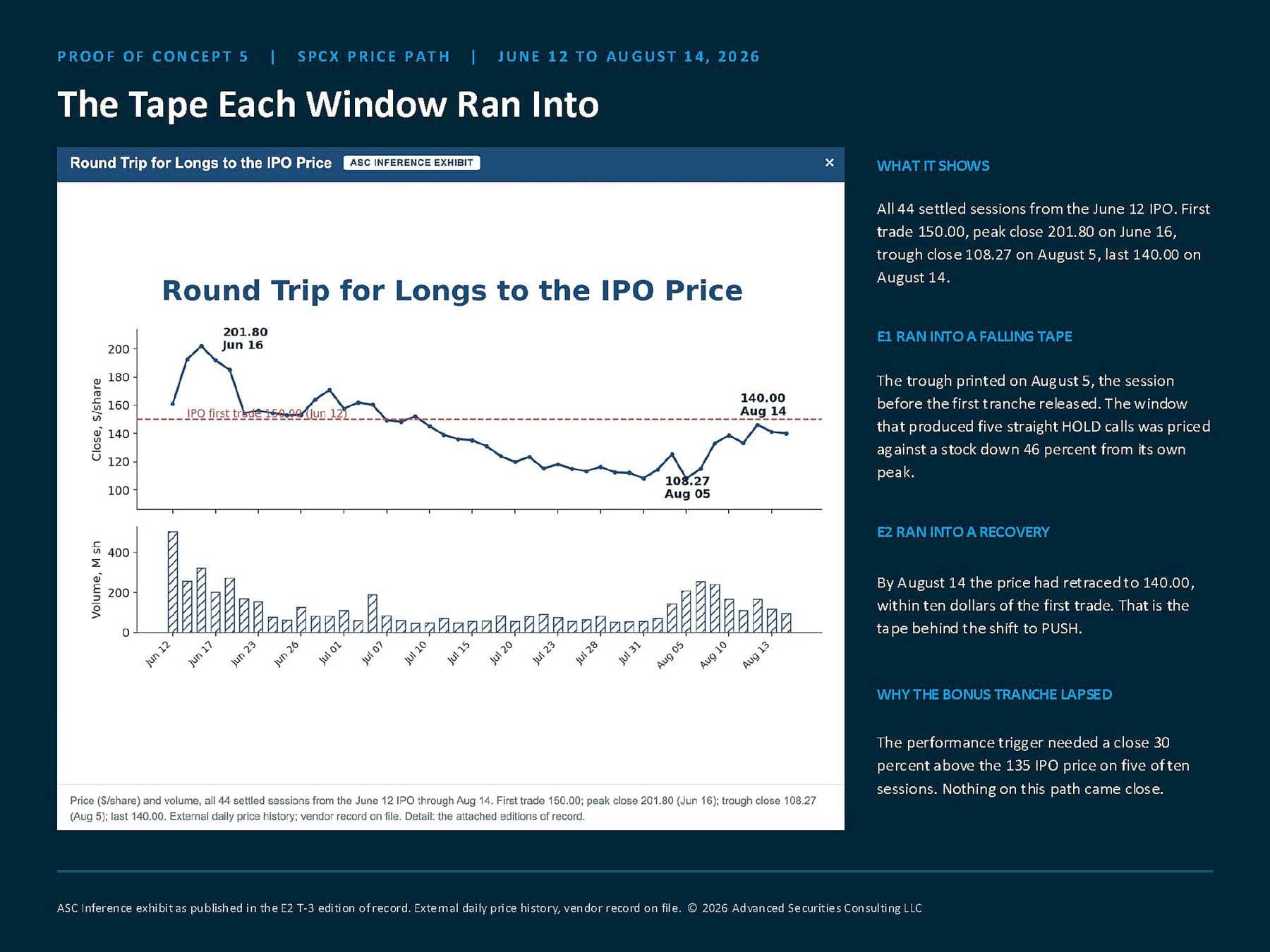
Exhibit 6. The tape each window ran into. SPCX price and volume, all 44 settled sessions from the June 12 IPO through August 14: first trade 150.00, peak close 201.80 on June 16, trough close 108.27 on August 5, the session before the first release, and 140.00 on August 14. Window 1 was priced against a stock down 46 percent from its own peak on closing prices; Window 2 ran into the recovery. The performance trigger for the conditional tranche needed a close 30 percent above the 135 IPO price on five of ten sessions within its measurement window, and the path did not meet it inside that window. ASC Inference exhibit as published in the E2 T-3 edition of record; external daily price history, vendor record on file.
Window 1: countdown T-5 to T+1
Thursday, July 30, T-5 | Intraday internal test, HOTTER X, scored in retrospect
Never distributed. Produced on the day the team fixed T-5 and set the scope; scored after the fact on September 2 as a control and failed against a settled change of minus 41.46 bp. The same day produced seven governance documents, among them the cross-instance reconciliation and independent-auditor adjudication amendments, and the Executive Director's request for a second human reviewer before the first edition went out.
I want the human in the loop (me) to have another human (you) backing up my ok-to-send.Executive Director, internal message, July 30, 2026, 10:53 ET
Friday, July 31, T-4 | Intraday, HOTTER at base strength Held
The edition led with the options market rather than the lending pit: option-implied borrow for the event week sat near 1,900 bp against 238 bp asked in the pit, a divergence the edition described as ASC's parity inference after the agentic auditor required that an inference not be stated as observed fact. Confidence capped at 75. Tape cutoff 12:29, export 14:44. A second AI instance reproduced the parity extraction independently (790 plus or minus 126 bp on the front segment). Settled change minus 54.07 bp; the pre-committed condition held on the settled spread and the inference did not lapse.
Monday, August 3, 08:40 | Morning alpha, HOTTER shifting toward COOLER Not scored
Internal, never distributed. Friday's settled data had fired both pre-committed shift conditions and the morning read leaned toward a shift. It was withdrawn at 12:17 when sixty live tickets showed re-rates overwhelmingly higher. Those shift conditions belonged to the morning read's own Rate Directive framework; the condition on which the July 31 edition is marked Held is the settled intrinsic spread, a different measure, and it did not lapse.
Monday, August 3, T-3 | Intraday, HOTTER at base strength Held
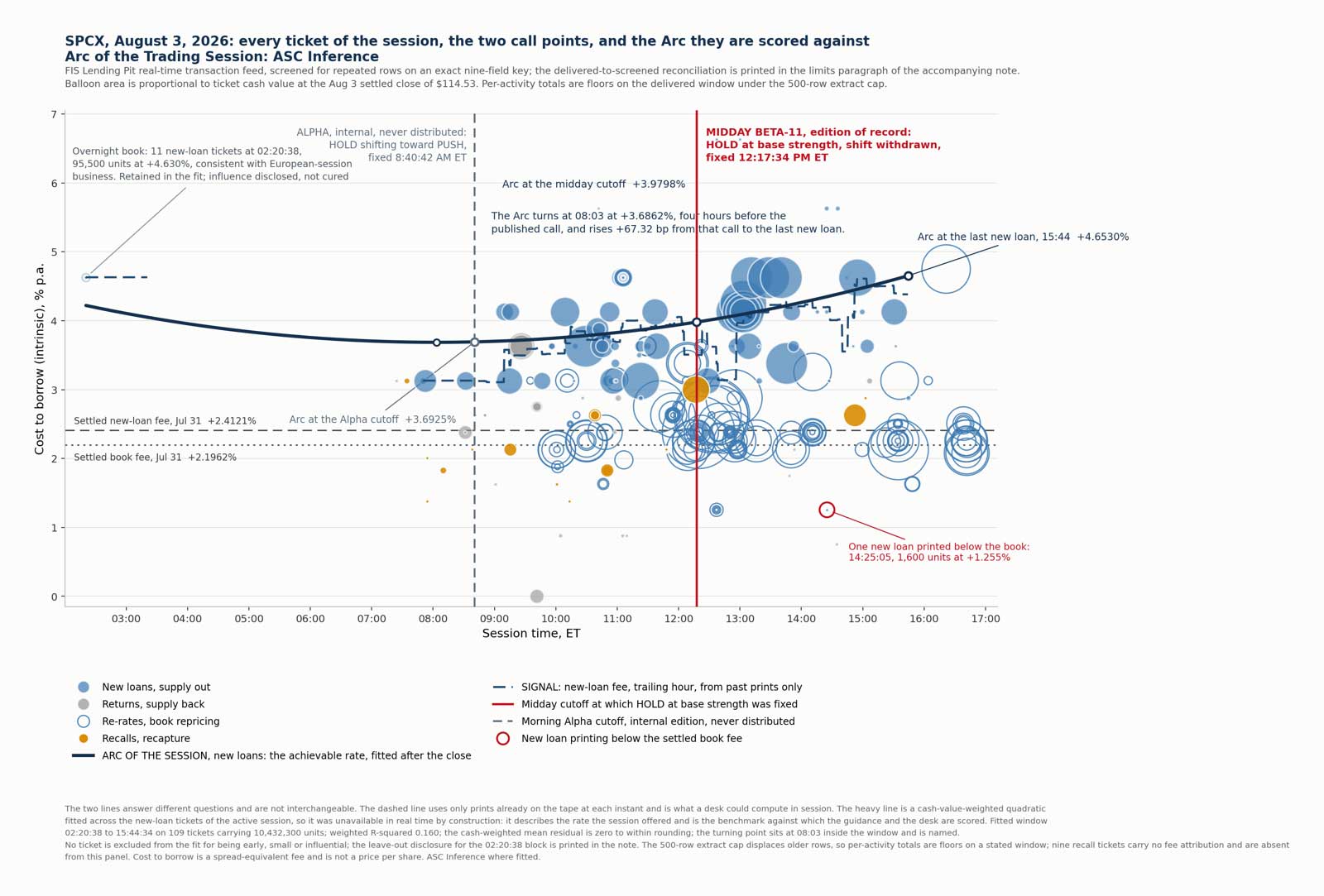
The distributed edition, Beta 11, held the HOTTER read and withdrew the morning lean, plainly, on the face of the document. Call fixed 12:17:34, sent 15:03. From the call to the last new loan the achievable rate rose from 3.9798 to 4.6530 percent, 67.32 bp. The fitted arc of the session had turned at 08:03, more than four hours before publication; the chart does not show that the call found the trough in real time. It shows that by midday the agentic analyst had recognized that Friday's deterioration no longer governed the live tape. Settled change +66.44 bp.
The morning's labeled shift toward PUSH was withdrawn, plainly, when the live session declined to confirm it. The tier table stays HOLD. … Friday settled fired both pre-committed shift conditions; Monday's tape did not confirm them: new loans +3.80% volume-weighted through 12:17 PM, ascending hourly to +4.06%, +160 bp over the book; the heaviest recall wave of the series (at least 2.05M units, panel basis); returns near a tenth of Friday's midday pace.SPCX T-3 Guidance, August 3, 2026, midday edition as issued. Historical record; the labels PUSH and HOLD were the edition's own and are superseded by the desk-neutral HOTTER and COOLER used on this page.
Exhibit 7. The call that changed the experiment. SPCX, August 3, 2026: every ticket of the session on the FIS Lending Pit real-time feed, the withdrawn morning alpha (08:40), the midday edition of record (12:17:34), and the cash-value-weighted arc of the session fitted after the close. The arc turned at 08:03 at +3.6862 percent; the published read fixed at +3.9798 percent; the achievable rate reached +4.6530 percent at the last new loan, +67.32 bp from the call. The dashed line uses only prints already on the tape at each instant and is what a desk could compute in session; the heavy line was unavailable in real time by construction. Balloon area is proportional to ticket cash value at the August 3 settled close. ASC Inference where fitted; chart reused from the ISLA Americas conference edition.
Tuesday, August 4, T-2 | Premarket, HOTTER Held
Titled Record Event Volatility Meets a Fully Utilized Lending Market and sent at 09:00 on the morning of SpaceX's first earnings report, the event that fixed the release date two sessions later; followed by an ASAP email. Settled change +74.23 bp; the condition held.
Tuesday, August 4, T-2 | Intraday, HOTTER, spread improving Held
Evidence fixed at 11:01, cover exported 14:24, about three hours twenty minutes later. A restated trader scorecard the next day recorded direction not confirmed at the midday stamp, then confirmed on the settled tape. The condition held.
Wednesday, August 5, T-1 | Premarket alpha, HOTTER Held, marked in retrospect
Finalized and not distributed. Its condition held when marked after the fact against a settled change of +116.09 bp; not counted in the five.
Wednesday, August 5, T-1 | Intraday, 11:30 cutoff, HOTTER Withheld as late
The edition reached recipients after the close, and the face of the document said so, with both reasons on ASC's side of the wire. Not scored. This is the window's one missed session and the record prints it as such.
Thursday, August 6, T-0 | Premarket and intraday, HOTTER, unqualified Held, both
Two blasts went out with control totals at 12:21 and stamps at 12:25 and 13:00: new loans 228 bp over the seasoned book pre-open, intrinsic spread at a series high of 204.9 bp on the FIS Lending Pit basis after three settled sessions of widening (the SpreadVectors repricing spread for the same date, shown in Exhibit 3, is +334 bp; the two series are constructed differently and are not interchangeable). The settled print cleared the pre-published falsification line by 151 bp. Settled change +199.13 bp. The lag from control totals to delivery was minutes. The T-0 guidance went out as a short flash with the full report behind it as the validation record, a format the covering letter to testers explained as a response to feedback that the complete reports can be overwhelming during the trading day.
Friday, August 7, T+1 | Intraday, COOLER, first of the window Held
The after-action edition turned to COOLER with 142 of 148 re-rate tickets moving down and new-loan intrinsic compressing from 3.11 to 2.02 percent by 12:30, and went out about fifteen minutes after its cutoff. Settled change minus 540.70 bp. That one down-call demonstrates a willingness to reverse, not a measured reversal rate.
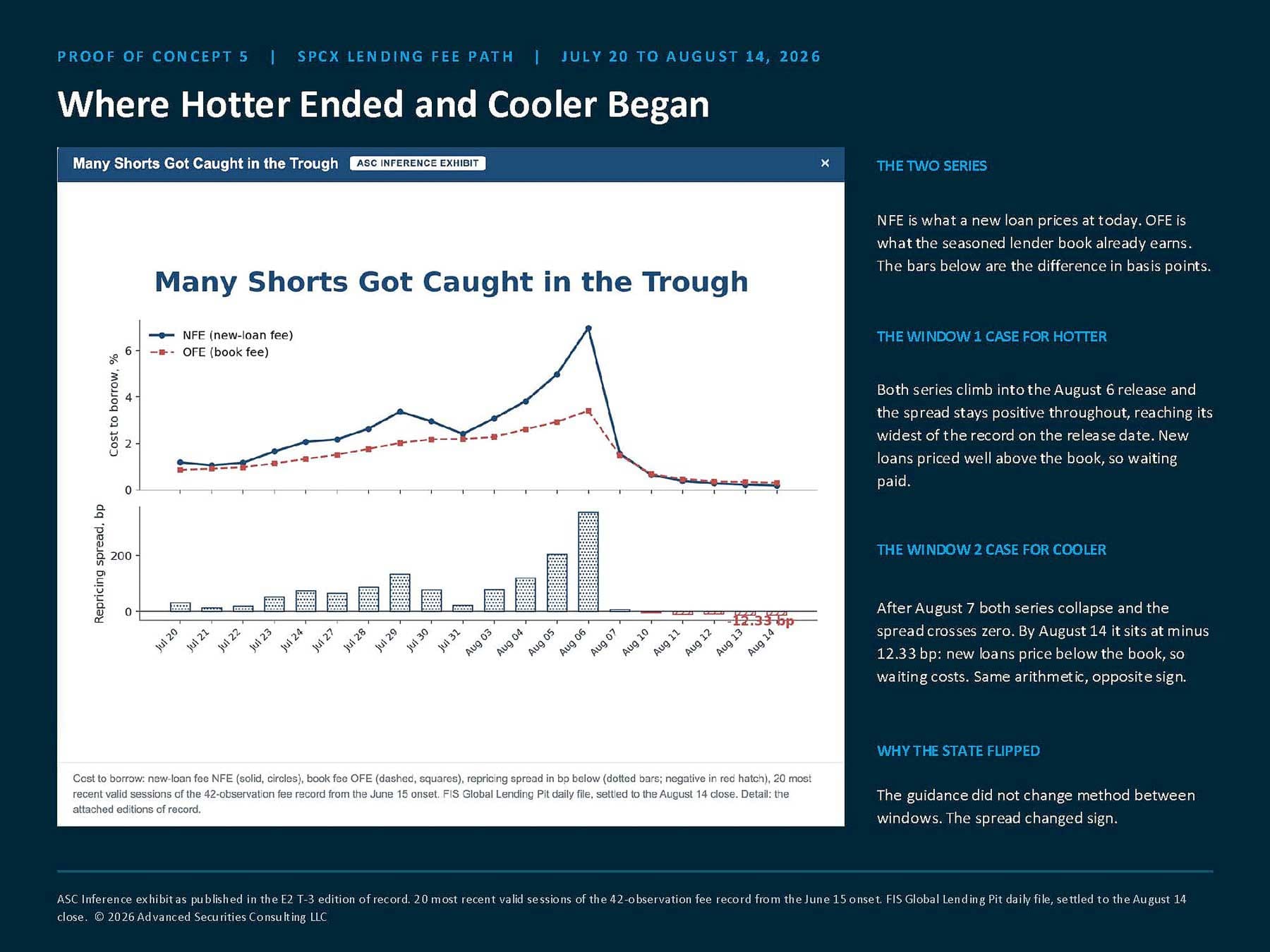
Exhibit 8. Where HOTTER ended and COOLER began. New-loan fee (NFE, what a new loan prices at today) and book fee (OFE, what the seasoned lender book already earns), with the repricing spread in basis points beneath, for the twenty most recent valid sessions of the 42-observation fee record from the June 15 onset. Both series climb into the August 6 release and the spread reaches its widest of the record on the release date; after August 7 both collapse and the spread crosses zero, sitting at minus 12.33 bp on August 14. The method did not change between windows; the spread changed sign. ASC Inference exhibit as published in the E2 T-3 edition of record; FIS Global Lending Pit daily file, settled to the August 14 close.
Window 2: countdown T-5 to T-0
Thursday, August 13 | Premarket and intraday market-state reports, internal alphas Not scored
Two internal editions with no desk-neutral state stated. They carried a first inference box built from the eight-model ensemble's output, which reported a direction confidence of 14 percent. Neither was published. The same day the inference box was specified to be built automatically from the daily prediction file rather than assembled by hand. Settled change minus 5.49 bp.
Friday, August 14, T-4 | Premarket alpha, COOLER, unqualified strength X, scored in retrospect
Finalized and not distributed. The edition went through a hard-fail audit with six findings, four cured and two rejected on the record, alongside eighteen anchored reviewer comments, and was reissued. Settled change minus 4.12 bp.
Friday, August 14, T-4 | Intraday, COOLER, unqualified; next-session level +0.0 to +19.4 bp Range contained point; not scored, Sept 3 record
The first distributed Window 2 edition, with direction confidence 78 percent and magnitude confidence 62 percent. Those figures are scores the reasoning model assigned on the 100-point confidence framework to the edition's own range; they are not the ensemble's 14 percent of the day before restated, and the two are not comparable. On the same day the human editing rounds were closed, with the machine self-audit and pre-delivery checklist retained on every edition. On this print the simple tape estimator built from the screened ticket feed was 1.15 bp from the settled fee against the naive carry's 4.12 bp, the one scored observation in either window on which any instrument beat the carry. Settled change minus 4.12 bp.
Monday, August 17, T-3 | Premarket, COOLER, unqualified; +8.6 to +15.3 bp Point above range, Sept 3 record
Edition of record R4, after two audit versions in which findings 2, 3 and 4 were accepted and finding 1 declined with stated grounds. Direction confidence 81 percent, magnitude 66 percent. The adjudicated point settled at 20.34 bp, above the issued range. Settled change +1.70 bp. The redesign for this edition put the call, the regime, the score and the release date at the top and printed the five-day and thirty-day trends so that a trader could judge the read independently.
Tuesday, August 18, T-2 | Premarket, COOLER, shifting; +14 to +22 bp Range contained point; release-quality standard failed
Delivered between 09:23 and 09:27, the first true pre-open delivery of the series. The edition carried defects its own same-day correction record identifies (a first-page overflow, a box-cell overload, a characterization of the short base); the corrected forms appear in the intraday edition of record (R4) later the same day, and no notice went to recipients. Sixteen audit findings were held for cure that day. Settled change minus 2.80 bp.
Tuesday, August 18, T-2 | Intraday, COOLER, unqualified; +14 to +20 bp Range contained point, Sept 3 record
Edition R4. The adjudicated point settled at 17.54 bp, inside the issued range. Settled change minus 2.80 bp.
Wednesday, August 19, T-1 | Premarket, COOLER, held; +15.69 to +17.54 bp Internal alpha, scored in retrospect
The real-time blotter for the day carried an anomalous trade, 2mm shares at 58%. The agentic auditor identified it before the edition went out, and the edition was held: nothing was distributed on August 19 while the print was checked with the data provider, and it was subsequently corrected from a new trade print to an internal adjustment. The hold is the auditor doing what it was built to do. Both August 19 editions are scored in retrospect against the adjusted data point. Settled change on the adjusted series +24.22 bp; three settled readings exist for this session and are reconciled in the technical report.
Wednesday, August 19, T-1 | Intraday, COOLER, unqualified; +13 to +19 bp Internal alpha, scored in retrospect
Prepared and held with the premarket edition on the same data question. Scored in retrospect against the adjusted point. Settled change on the adjusted series +24.22 bp.
Thursday, August 20, T-0 | Premarket, HOTTER shifting; at or beneath +20 bp Held, not issued
The two-stage build refused to distribute an edition built on a tape whose manifest and schema did not reconcile. Two audits were run with five findings each, one escalated. The edition was held. Its read had shifted toward HOTTER after the +24.22 bp session of August 19, the only HOTTER read in the second window; it was never issued and is not scored. The hold counts against speed on the day and this report prints it that way. The Executive Director's ruling on the record: the rules working, not a fault.
Thursday, August 20, T-0 | Intraday, COOLER, unqualified; range not resolvable Not issued
Not issued; so recorded on the September 3 record. Settled change on release day minus 17.10 bp.
Exhibit 9. Settled change by countdown date, both windows. Each bar is the change in the settled new-loan fee from the prior settled session; the label beneath is the market state as issued in that day's edition of record; an asterisk and italic mark days whose only editions were internal (the July 30 test; August 5, where one alpha was finalized and not distributed and the intraday edition was withheld as late; and August 19, whose two editions were held on the agentic auditor's data question), August 13 carried no state, and August 20 was held. One Window 1 edition, July 31, read HOTTER on a day the fee fell and is marked Held, because Window 1 marks are made on the settled intrinsic spread under each edition's pre-committed condition, not on this column; the other such day, July 30, is the internal control that failed. August 19 is shown on the adjusted series, after an anomalous blotter trade (2mm shares at 58%) was reclassified from a new trade print to an internal adjustment. Every distributed Window 2 session sits inside the five-basis-point flat band, so the distributed Window 2 editions regret under the retrospective diagnostic (Retrospective; defined in Section 3, fixed September 8) because the tape was flat, not because direction was called wrong; August 19, whose editions were held, moved against the call and is outside the distributed set. The three Window 2 sessions outside the band, August 13, 19 and 20, are the three with no distributed edition: August 13 carried internal alphas only, and the August 19 and 20 editions were held. Source: inference panel of September 7, 2026; September 3 settled record.
Section 6Market Consensus vs. Model Assessment
With the record in view, the two windows can be set against what was expected of them. They posed different questions.
Window 1: the release of August 6
Window 1: the supply-deluge hypothesis against the distributed editions, by dimension
Dimension
Expected: the supply-deluge hypothesis
Read: the distributed editions
Direction of the new-loan fee into the release
Released shares reach lending supply, borrow demand is met, the achievable rate eases
HOTTER through the countdown; demand still paying up on live tickets; new loans printing above the seasoned book
Stock price
Selling pressure from released holders pushes the price down
Not called by the editions; the price fell to its low close of 108.27 the session before the release and rose through the window, 112.20 on July 30 to 133.11 on August 7
Supply at the cap
Utilization relieved by new lendable inventory
Utilization printed 100 for a third consecutive session on August 3 while on-loan fell; the pool was shrinking
Options channel
Not part of the deluge thesis
Event-week implied borrow near 1,900 bp in the July 31 edition against 238 bp asked in the pit that day; +1,270 bp on the August 3 synchronized window, captured after the 12:17 call; stated as ASC inference, not observed fact
What would falsify the read
Not stated in advance
Two consecutive settled narrowings of the spread, or new loans at or below the book; both directions pre-committed in writing
Reversal
Expected at or before release
Called COOLER on T+1, August 7, with 142 of 148 re-rate tickets moving down
Window 2: the release of August 20
Window 2: the post-release easing expectation against the distributed editions, by dimension
Dimension
Expected: post-release easing
Read: the distributed editions
Direction of the new-loan fee
After the first release repriced the book, a second release eases the fee further
COOLER on every distributed edition, August 14 to 18
Magnitude
Not quantified
A range in basis points on the next session's settled new-loan fee, with a stated direction confidence (78 to 81 percent) and magnitude confidence (62 to 66 percent)
What the fee did
Moved less than five basis points on August 14, 17 and 18; the August 19 editions were held when the agentic auditor questioned an anomalous blotter trade, later reclassified as an internal adjustment; the release-day move was 17.10 bp down
Where expectation and reading differ
They did not differ on direction. The distributed editions and the easing thesis agreed, and a settled fee that barely moved gave neither one anything to be right about. The test in Window 2 was magnitude, which is the question the quantitative rung was built to answer and could not answer on a settled record of some forty sessions
Section 7Conclusions
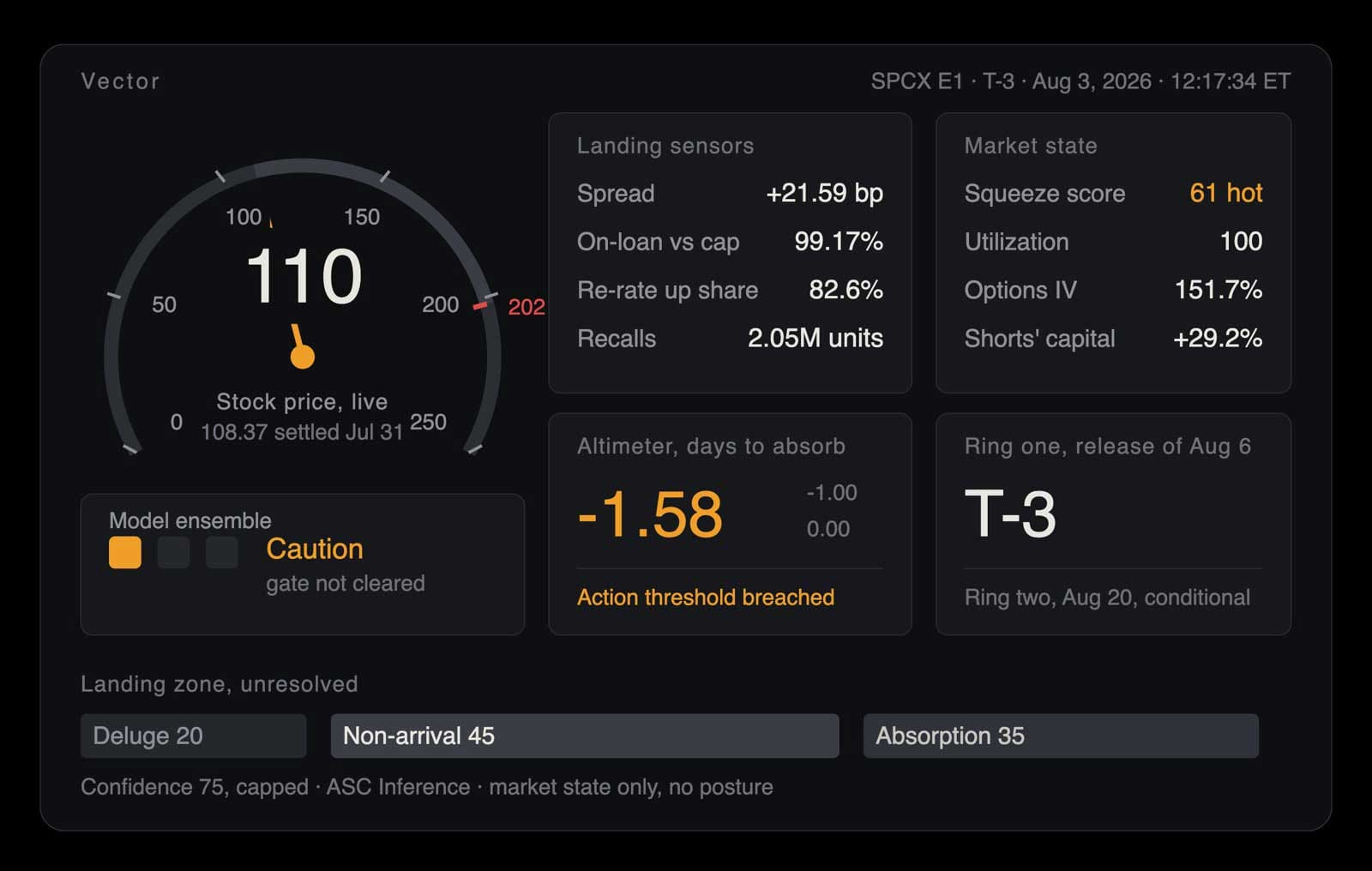
Exhibit 10. Vector: the instrument panel at the T-3 call, August 3, 2026, 12:17:34 ET. A retrospective design study, rendered in September 2026 from the reconstruction of the August 3 read; it is not a screen that existed on August 3. Landing sensors: repricing spread +21.59 bp, the July 31 settled repricing spread and the last settled print available at the call (the +160 bp in the August 3 quotation is the live midday margin of new loans over the book, a different construction), on-loan 99.17 percent of cap, re-rate up share 82.6 percent, recalls 2.05 million units. Market state: Squeeze Prediction Score 61 (HOTTER), utilization 100 (the figure of record; the panel's on-loan at 99.17 percent of cap is a different measure, units on loan against the lendable cap), options implied volatility 151.7 percent, shorts' capital +29.2 percent. The altimeter shows days to absorb at minus 1.58 with the action threshold breached; the model ensemble indicator reads Caution, gate not cleared, which is the rung-fitness decision of Section 3 on the panel face. The landing zone shows the reconstruction's three-path weights (Deluge 20, Non-arrival 45, Absorption 35); these are design weights, not scored probabilities, and the page attributes them to the reconstruction, not to the edition as issued. Confidence 75, capped. Market state only, no posture.
For a reader who has skimmed, the record comes to this. Twenty-two dated editions were made between July 30 and August 20, 2026, across the two SpaceX lockup releases: distributed, internal, withheld and held, every one printed above in the order it was made. In the first window, five distributed editions carried a market-state read into and through a release with no precedent, HOTTER through the countdown and COOLER the day after, each with a condition stated in advance that would have lapsed it, and none lapsed: five of five held through settlement, and the turn to COOLER on August 7 came on 142 of 148 re-rate tickets. In the second window, the distributed editions carried a range and a stated confidence on a fee that had collapsed from 697 bp to under 30 bp between the two releases, and under the retrospective direction diagnostic all six regret; the page does not claim a Window 2 edition as a hit. The settled fee moved less than five basis points on every session with a distributed edition, one issued range saw the point fall above it, and two days of editions were held because the auditor would not pass the data.
What the numbers describe is a governed process rather than a forecasting contest. The eight-model ensemble never cleared its 90-session validation gate on a name whose settled fee record began June 15, and its output entered no distributed edition; the reasoning model, the language-model layer, produced every read, wrapped the Window 2 output in the terms on which it would be scored, and stopped the line twice, on August 19 when an anomalous blotter print (2mm shares at 58%) was questioned and on August 20 when a tape did not reconcile. The human contribution became reusable along the way: rulings on conflicting instances, on lateness and on unreconciled tapes became instructions used in later runs, so the human checkpoint got shorter because the system arrived better prepared. The second window's result is printed as plainly as the first's because the first would not be credible without it.
The governance the loop produced is now written where a machine can use it, and that is what makes it transferable. The inference state record (ISR, v1.0, September 10) fixes the fields ASC's models deliver to a client AI: state, score, range, confidence, pre-committed conditions and provenance. The range-construction method and its backtest across both windows (September 6) fix how an inference box is drawn from model output. The daily process guide for the TSMixer refit (September 13) and the linear-model specification (September 10) fix which rungs run in ASC's shop, on what history, and how they are scored. The Project Instructions, version-controlled as prompts-as-code, and the context files of the earlier events (KLAR, CoreWeave and Lennar) and of the SPCX windows themselves are what a tester's agentic analyst would read from on the first morning of its own countdown. The quantitative AI models did the arithmetic; the language models, the reasoning model, did the reading and the checking; a person signed. The next test of the arrangement is whether it holds when the reading is done on someone else's desk. ASC demonstrated a governed inference process that knew when to use a model, when not to use one, when to change its view, and when not to publish at all.
Administrative notes. The population rule scores only editions distributed to beta recipients. The September 7 ruling fixes the panel at fifty-one inferences: twenty-nine produced before the first countdown, of which the twenty-eight dated June 24 to July 30 are excluded as pre-feed, and the twenty-two of the two countdown windows printed on this page. The July 30 date appears on both sides of that line: an annotated note produced before the countdown opened sits in the pre-countdown twenty-nine, and the July 30 internal test printed on this page is the first countdown edition. Window 2 row-level marks await reconciliation of the denominator and the range rule. The magnitude test is reported as not resolvable.
Request the technical report
See how every call was scored
Request the complete technical performance report.