
SPCX: The Microeconomics of Short Selling
into the Largest IPO in History
And What the Structure Means for Every AI Offering That Follows

The S-1 registration statement for Space Exploration Technologies Corp. was filed with the SEC on May 20, 2026 (accession number 0001628280-26-036936). All lockup terms cited in this analysis are sourced from that filing. Critical caveat: the total number of shares subject to the staggered ladder and the exact percentage of outstanding stock eligible for early release remain redacted in the preliminary prospectus. All tranche percentages are of "eligible shares," defined as locked shares excluding Musk and significant investors; the size of that eligible pool is an estimate based on pre-IPO ownership reporting and will be confirmed in the final prospectus. The 5-for-1 stock split was effective May 4, 2026; any secondary market pricing prior to that date requires adjustment before comparison to post-split figures.
The SpaceX S-1 answers the structural questions the securities borrowing and lending (SBL) market has been asking since March. The offering is raising approximately $75 billion. Elon Musk will not sell a single share at the IPO; only SpaceX as an entity is selling. There is no 180-day lockup cliff. There is a nine-event staggered ladder spanning 180 days, followed by a far larger event at Day 366 that most current analysis has not yet priced.
The three structural features that define this offering as a template rather than just a large deal are: the nine-event ladder itself, which replaces the single binary event that governed CoreWeave and Klarna; the explicit exclusion of Musk and significant investors from all early-release provisions, with a 366-day hard lockup confirmed in the S-1; and the Nasdaq Fast Entry rule, which creates a forced index-buying demand offset at the same moment early tranches are releasing supply. Each of these features is new at this scale. Each is likely to reappear in the Anthropic, OpenAI, Anduril, and Databricks offerings that follow.
The central finding from the supply shock arithmetic is this: the entire nine-event eligible pool across the first 180 days represents approximately 28 percent of total shares outstanding. Musk's stake and those of significant investors, locked until Day 366, represent approximately 68 percent. The Day 366 event is 2.4 times larger than everything that happens in the first six months combined. At IPO-price valuation, the Day 366 supply event is approximately $1.24 trillion. It is the terminal supply event, and it arrives approximately one year post-listing.
The Structural Template
Why SPCX Sets the Mold for the AI IPO Cycle
The question this analysis addresses is not how large SpaceX is. The market has priced scale. The question is which structural microeconomic features this offering has introduced at scale for the first time, and how many of them will define the lending market dynamics for every large AI company that follows it to public markets.
Three prior AI-adjacent IPOs give the comparison set. CoreWeave in March 2025 raised $1.5 billion at a $23 billion valuation with an 11 percent initial float and a standard 180-day cliff lockup. The stock climbed from $40 to above $183 within three months. Borrow utilization hit 100 percent. Short sellers who established positions against the dilution math were squeezed because narrative persistence overrode supply mechanics for longer than any standard model projected. Klarna in September 2025 raised $1.37 billion at a $15 billion valuation with a roughly 10 percent initial float and a standard 180-day cliff. The market priced general collateral rates ahead of lockup expiry. ASC's analysis identified, four trading days before the Monday expiry, that 259 million of the 335 million locked shares were structurally blocked by a depositary conversion process. Cost to borrow hit 68.62 percent at Monday close. The calendar date was not the supply event. The mechanics were.
SpaceX inherits both lessons and multiplies them by a structure neither CRWV nor KLAR had.
The features that make SPCX a template rather than an outlier are precisely the ones that will recur in subsequent AI offerings. Founders of companies valued above $500 billion do not want a single 180-day cliff determining their public market debut's supply dynamics. Staggered release, performance-linked triggers, and founder exclusion from early provisions are each rational design choices at this valuation scale. The Nasdaq Fast Entry rule was amended explicitly with this class of company in mind. The structure SpaceX has implemented is not an accident. It is a playbook that other AI companies will study and adapt.
The Nine-Event Supply Ladder
Share Counts, Dollar Values, and the Arithmetic of a Lendable Pool That Starts at 4 Percent
The supply shock arithmetic requires working from the total share count, which the preliminary S-1 redacts. The following estimates are derived from the December 2025 SpaceX tender offer to insiders ($421 per share pre-split at approximately $800 billion implied valuation), retroactively adjusted for the 5-for-1 split effective May 4, 2026. The implied IPO price at $1.75 trillion target valuation is approximately $184 per post-split share.
The Q2 earnings cliff is the single most important SBL event in the 180-day window. At 20 percent of the eligible pool, it adds 554.9 million shares and more than doubles the lendable pool overnight, from 407.2 million to 962.1 million shares. In dollar terms, it adds $102.2 billion of theoretical lendable supply to a float that opened at $75 billion. It is also the first moment at which the performance trigger becomes relevant: if SPCX has traded 30 percent or more above the IPO price for at least five of the ten trading days before the Q2 earnings release, an additional 10 percent, or 277.4 million shares, becomes simultaneously eligible. If both fire, the cumulative lendable pool at that single event reaches 1.239 billion shares, a 204 percent increase from Day 1.
The five calendar-based tranches between Day 70 and Day 135 each add 194.2 million shares, incrementally growing the pool by between 9.6 and 15.7 percent per event. Each is meaningful in absolute terms; at $35.8 billion per tranche at IPO-price valuation, each event is individually larger than the entire Klarna IPO. But the incremental percentage change diminishes across the series as the cumulative base grows, which is the ladder's evident design intent: supply expands steadily rather than arriving in a destabilizing single wave.
The Q3 earnings cliff at 28 percent of the eligible pool is the largest single early-release event in the entire ladder. It adds 776.8 million shares and grows the cumulative lendable pool by 35.1 percent in a single event, arriving six to nine months post-IPO when the narrative has had time to develop and holders have had a full earnings cycle to assess their positions.
By Day 180, the cumulative lendable pool has reached 3.182 billion shares, or 32.1 percent of total shares outstanding. That is the number that will be on most desks' radar as the "lockup expiry" event. It is not. The lockup expiry for 32 percent of the company is Day 180. The lockup for 68 percent of the company is Day 366.
Day 366: The Structural Supply Event the Market is Not Modeling.
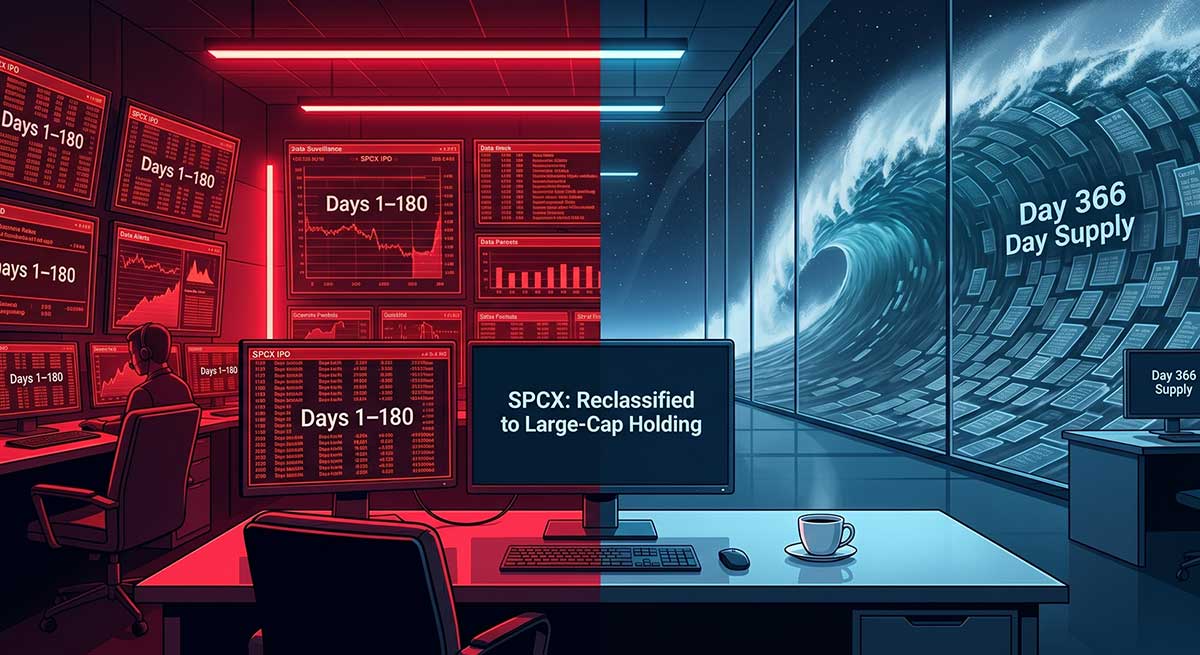
While near-term market attention remains fixed on early lock-up expirations, the true terminal liquidity event for SPCX occurs on Day 366. On approximately June 12, 2027, the expiration of the primary insider lock-up releases an unprecedented block: Elon Musk’s stake combined with a highly concentrated investor cohort, totaling roughly 6.738 billion shares. At IPO-price valuations, this represents a theoretical $1.24 trillion structural event—16.5 times the initial public float and 2.4 times the aggregate volume released across the first 180 days.
The risk here is misunderstood. Market consensus assumes Elon Musk will not liquidate equity and risk ceding voting control of SpaceX. However, outright selling is not the only mechanism that alters market clearing prices. The institutional mechanics of Day 366 introduce a quieter, more potent market force: the immediate optimization of lendable supply.
While Musk retains his voting power, secondary mega-investors will look to liquidate, and institutional custody desks will systematically move dormant insider shares into institutional securities lending programs. This structural assignment into the lendable pool will instantly collapse the cost to borrow, removing the historical friction that restrains large-scale short positioning.
This supply deluge arrives precisely when peak post-IPO surveillance has decayed, trading desks have reclassified SPCX as a seasoned large-cap holding, and financial headlines have shifted to competing AI architectures. The terminal supply event—and its profound impact on borrow dynamics—remains entirely unmodeled on institutional calendars.

The Squeeze Question
What Happens When Unlocked Shares Do Not Enter the Lendable Pool
Three conditions must hold simultaneously to convert a tranche release from a supply event into a squeeze catalyst:
Condition 1: Short interest has built against the valuation multiple. At 73 to 94 times trailing revenue (varying by revenue estimate), SPCX presents one of the most mathematically coherent short theses in the market. A company with $4.94 billion in GAAP net losses in 2025, incorporating an AI subsidiary acquired in an all-stock deal two months before IPO, trading at a multiple that implies flawless execution across launch, Starlink, xAI, and orbital AI compute simultaneously, will attract institutional short sellers. The thesis is sound. The timing is the problem.
Condition 2: Unlocked holders choose to hold rather than sell or lend. This is the CRWV lesson applied to a nine-event ladder. CoreWeave's short sellers were correct about the dilution arithmetic. They were devastatingly wrong about when supply would arrive, because holders sitting on 300 percent gains in three months had no rational incentive to sell, and no operational incentive to enroll in lending programs. Each SPCX tranche presents the same decision to a different cohort of insider holders: sell into a market that has validated your thesis, or hold for further appreciation. If the stock is up 30 percent at Q2 earnings, the performance trigger fires and the question becomes whether 277.4 million shareholders, sitting on 30 percent gains in six to ten weeks, will enroll those shares in lending programs rather than consolidate their gains or hold for the Nasdaq 100 inclusion tailwind.
Condition 3: FPL enrollment rates at the retail custodians lag the release schedule. The retail allocation of up to 30 percent of the offering, routed through Robinhood, Fidelity, eTrade and Charles Schwab, creates a beneficial owner base that is enrolled in lending programs at varying rates. Fidelity and Schwab manage mature FPL programs with established enrollment workflows. Robinhood's program is younger and has not processed a single-name position of this scale. The retail holders who receive SPCX at IPO price and hold through the nine-event window are potential lendable supply only if their account is enrolled in a fully paid lending program at one of the five selected retail brokers and their custodian has operationally handled the position. The enrollment rate at each custodian in the first weeks of trading is the most direct indicator of how much of each tranche actually reaches the lending pool.
Looking forward, the performance trigger is the most acutely squeeze-prone event in the ladder. It is the only tranche that can fire only when short sellers are already losing. If SPCX trades 30 percent above IPO price for the required window before Q2 earnings, every short position established at or near IPO is underwater by at least 30 percent. The cohort of holders whose shares become eligible at that moment would be sitting on the largest gains of any group in the entire ladder. They are the least likely of all insider cohorts to enroll in a securities lending program that, in their minds, would benefit short sellers and hedge funds. The tranche is labeled a supply release. In practice, under these conditions, it may arrive in the lending market with close to zero enrollment.
The Q3 earnings cliff is the highest-risk single event for KLAR-style mechanics failure. At 28 percent of the eligible pool, it is the largest early-release tranche by a wide margin. It arrives six to nine months post-IPO, when the institutional memory of the KLAR mechanics lesson has faded and desks have settled into a rate pattern. The eligible holders at this tranche are those who have held through the entire Q2 earnings event, through five calendar tranches, and are now releasing at the Q3 earnings moment. The concentration of 776.8 million shares at a single earnings event creates the same preconditions KLAR presented: a large tranche arriving at a known calendar date, priced by the market as a supply event, with mechanics that may constrain actual delivery. Form 144 silence in the 30 days before Q3 earnings is a primary early warning signal.
The explicit answer to whether shorts can be squeezed at individual tranche events: Yes. At the performance trigger and at the Q3 earnings cliff, all three conditions described above are structurally plausible. The CRWV template is the better comparison at both events. The KLAR template applies to the mechanics risk at Q3 earnings and at Day 180.